Dec 22, 2025
 3 min read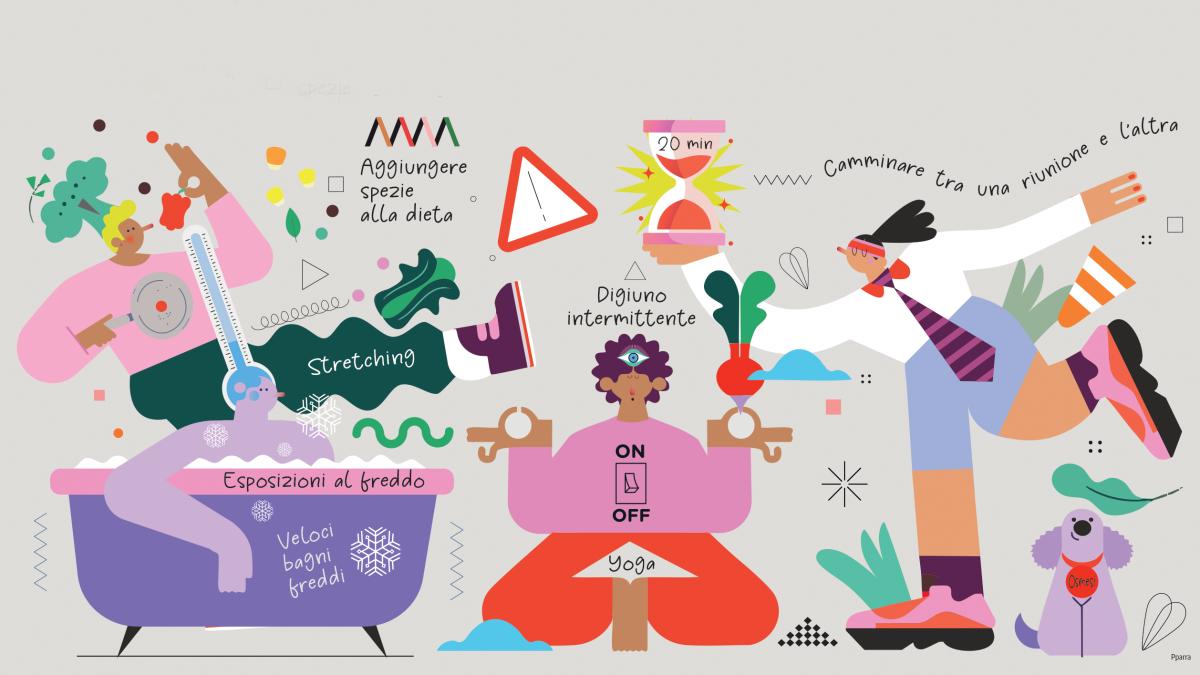
"We are the first species to think of rest as a biological state," says neuroendocrinologist Ascanio Polimeni."But the body is designed to change, not to stay down like a stationary thermometer: constant stress is dangerous, but food and balance improve the body's ability to heal itself. There is no need to suffer: a useful guide."
Interruption of food, thermal shock, interval training: it will not be punished by micro-stress, it will prolong life.This is the concept of hormesis
"We're the first species to consider a biological condition to be alleviated," says neuroendocrinologist Ascanio Polimeni.But the body fluctuates instead of being flat like a constant thermometer: too much constant stress can be dangerous, but dose and balance improve the body's ability to repair itself.No need to suffer - a practical guide
For years, we have said "I'm stressed" like we say "I'm hungry" or "It's cold": a daily reality.We have turned stress into a symbol of modernity, an omnipresent enemy to which we attribute everything that does not work.But behind this cultural reflection, biology continues to tell a different, more subtle, almost counterintuitive story: not all stress is bad.
Certain types of stress, if dosed, are fundamental to a better and longer life.This is the principle of hormesis (from the Greek hormesis, to excite or stimulate), a U-shaped dose-response curve that brilliantly describes how a small stimulus can produce large changes.This is a new technique in longevity research, which is now being used in preventive medicine and lifestyle medicine to improve cellular health and quality of life.
Accompanying this interpretation is the neuroendocrinologist Ascanio Polimeni, director of the LongevYa Project and the Regen4Life Research Group, which has long been investigating how the body responds to microstimuli."Biology does not like extremes, it likes fluctuations," he says with a simplicity that does not hide the elegance of the concept.We are designed to react, to contract and relax, to heat and cool, to move from abundance to scarcity.But our era has removed all vibration and created a flat, flawless and - paradoxically - non-physiological habitat.The lack of daily variety, from thermal to nutritional variety, impoverishes our internal resilience, making the body more vulnerable to even minimal challenges.And it is no coincidence that people older than centenarians, observed in various long-lived populations, are often people subjected to little or only partial stress: their organism extinguishes the ignition with a surprising speed, almost automatically.
The heart of the idea is simple: small strains learn the cell.They stimulate mitochondria, activate HSPS (heat shock proteins, proteins that protect cells from damage), regulates metabolic pathways such as MTOR (stimulates growth and energy storage) and AMPK (activates energy saving mechanisms), where the body removes waste and repairs internal structures.Process.It is a biochemical ballet that is activated only when a challenge is faced and never comfortable.And when this ballet is defective, we pay with chronic inflammation, weakness, loss of muscle mass and premature aging.
Centenarians are an example: their bodies extinguish the flame of inflammation with almost automatic speed
Ultra marathon runners, for example, often experience extreme stress: the body resists if the exposures are calibrated and integrated with recovery, but collapses if the intensity is continuous and without breaks.Their extreme performance is a living demonstration of how hormesis has limits: too much sustained stress becomes harmful, but dosed and balanced it restores normal resilience.can improveIt's no coincidence, Polimani says, that ultramarathon runners don't show a good aging profile: with very persistent weight, their life expectancy overlaps that of obese people, suggesting that excessive and persistent stress is just as harmful as caloric excess and a sedentary lifestyle.
The scientist points out that it seems provocative, but it is not: We live in captivity of excessive protection.Constant temperature, continuous feeding, elegant sedentary lifestyle, unfailing habits."We're the first species to see comfort as a biological state," he smiles.In fact, this is a cultural state that physiology has never accepted as an ideal.
Physiological normalcy, he explains, includes daily, weekly and seasonal fluctuations: the body is designed to fluctuate, not stay flat like a static thermometer.This concept will be one of the central points of the book that the specialist will publish in the spring for Sperling & Kupfer, a practical and scientific guide on how to rework microstress in everyday life to live better and longer.
Example: desert rats
It is important to understand what stress is: Do you have heartburn?Are you enlightened?Can't sleep?You are confirmed.Do you have a headache?You are confirmed.Did you miss your time?You are confirmed.Many common symptoms are nothing more than signs of axle load development.
This is brilliantly demonstrated by desert mice, animals studied for years by adaptive physiologists.They live in harsh environments with extreme temperature changes, intermittent food availability and the need for constant movement.Yet they have excellent metabolic efficiency, low systemic inflammation and remarkable longevity compared to other related species.The secret is natural hormesis, constantly calibrated by the environment.Microstresses that keep repair and defense systems active.Life cannot develop in the absence of stimuli, but in their modulation it is living proof.
Stomach ache?In your head?These are symptoms of pressure axis overload: the solution, however, is not complete relief
From this principle, the researcher derives a simple and profound human system: to bring back to everyday life the stimuli that our modernity has erased.The first is the break from eating.Not extreme fasting, but breaks.Hours when the body does not receive energy and can deal with internal maintenance.During this time, AMPK is activated, mTOR is reduced, autophagy pathways are opened.The cell is not weakened: it is restored.It's a mechanism we've known for millennia and only learned about in recent decades, turning the day into a constant flow of calories.Even small jumps in calories throughout the day, such as skipping an afternoon snack or cutting back on breakfast, can act as beneficial micro-stressors.Specific examples: eating breakfast later, skipping a light meal or taking a brisk walk before main meals.The scholar adds: "There's no need to suffer: just give the body a chance to do its job."sugars overload the body with metabolic toxins, making it much harder to put out the fire of inflammation: more sugars, less ability to recover.
It is a moderate effort, but every day
The same logic applies to sports. The modern absence of intensive training obscures the simple truth: The body responds better than usual to bravery. Moderate daily effort can harmoniously activate the hypothalamic-pituitary-adrenal axis without being overwhelmed. Fast walking, light resistance exercise, regular exercise. This is a dialogue, not a war, between the muscles and the system.neuroendocrine. Research shows that even intermittent training, where the effort is replaced by recovery, activates the hormonal axis more effectively than continuous continuous activity. For example, Mark Matson studied mice exposed to harmful stimuli and showed that continuous stimulation, such as maze-like paths and limited movement, increases resilience and reduces the development of chronic diseases compared to stimulation groupsbelow. For this reason, experts remind us that "exercise does not only shape the body, it shapes the flexibility of the entire system." Even short bursts of yoga or movement can turn into a healthy low-stress if done regularly with daily yoga or movement.
Eat breakfast or skip a light lunch, add a brisk walk before eating
An important chapter is concerned with thermal oscillations, the most irrational stress and the one that we have eliminated the most.We are thermostated, we can not stand the wind blowing.But the biology responds well to thermal stimuli: the cold activates the shock protein (HSP), brown fat (brown fat: fat that burns energy to heat), good vascularization;When the heat is hot, sweat, exchange energy and freedom for the heart.Again, there is no need to suffer: you need to live a little in reality.Even short for the cold or go to the light sauna, changing temperature and cold, like to increase the capacity of the cells.
The same is true for hormones, compounds found in food cause micro-stresses in cells.Polyphenols from fruits, bitter compounds from plants, sulfur compounds from essential vegetables, hot herbs: they are not miracle drugs, but cellular trainers.Plants produce them for protection.By accepting them, we activate the same defense mechanism.Some studies cited by Leo Pruimboom have shown that regular consumption of these nutrients induces anti-oxidant and anti-inflammatory effects, increasing cellular resilience.Not surprisingly, many of these molecules act on proteins like hormones.Regular intake of these substances appears to modulate inflammation and increase antioxidant capacity, a small endogenous chemical "exercise" that supports longevity.Among these foods, polyphenols refer to specific vegetables, broccoli, cabbage, spinach, turmeric, turmeric, red grapes, green tea, dark chocolate and olive oil: true "rejuvenators" of inflammation, able to calm the long-lived biological soil.
skill for training
In the work of scientists, what strikes us most is not technology, but cultural reading.The idea that health is not the absence of disorders, but the ability to react.Longevity is not a prize to be won, but a skill to be practiced.That old age is not the breakdown of an exhausted system, but the result of a life that knows how to communicate with pressures rather than avoid them.It is a call to rediscover natural rhythms, to reintroduce small challenges to daily routines, to see life as a laboratory micro-adaptation.The scientist emphasizes how this approach, presented in the forthcoming book, is accessible to everyone: no big revolutions are needed, but conscious attention and small daily changes.
Broccoli, green tea, dark chocolate, curry: Soothes the organic soil upon which longevity is built.
Ultimately, his vision restores the dignity of an ancient truth: we are born to adapt.Adaptation, however, is achieved not by fixing problems, but by calibrating small fluctuations - a little hunger, a little cold, a little movement, a little intense taste, a little variation - that restore the strength of our defense systems.Adopting these principles does not require extreme revolutions, but daily observation and micro-interventions and can radically change the quality of life over the years.Polymeni also clearly distinguishes different types of stress: acute stress, classic stress associated with illness or a sudden event;psychological stress due to mental stress;and chronic stress is the real enemy number one because it includes, reinforces and worsens all stress.And it is precisely in the space between them that positive stress arises, which educates and does not harm.
"A good stress is a teacher," Polimeni concluded."He doesn't punish you: he teaches you."And this sentence is perhaps the best synthesis of his ideas: life is not long by avoiding all difficulties, but by learning to use them.Each oscillation, each small stress, each calibrated challenge, becomes a brick in the construction of strength and long-term health, less dazzling but firmer the way to a significant and important age.
two pressures
Traditionally, stress has been viewed as negative and as a cause or contributing factor to disease.
In fact, it is important to distinguish two types of stress:
1) severe stress, which is a specific event (for example, disease, bite, trauma) that activates inflammation, followed by anti-inflammatory that "puts out the fire".This is a physiological adaptive mechanism;
2) Chronic stress, caused by a combination of conditions (psychological, metabolic, environmental ...) that causes a constant pro-inflammatory reaction, unable to "reset" the system.Often due to poor, sedentary conditions;
environmental effects, psychological stress